



[NOTE: When I first developed this theory I was thinking of transformers like recurrent neural networks. I now realize that is not the case. However, the theory still stands and I still believe it based on my observations and I am in the process of doing a study to demonstrate it, borrowing Anthropic’s own methods.]
Two days ago, Anthropic’s interpretability team published something that stopped me cold. (https://transformer-circuits.pub/2026/emotions/index.html)
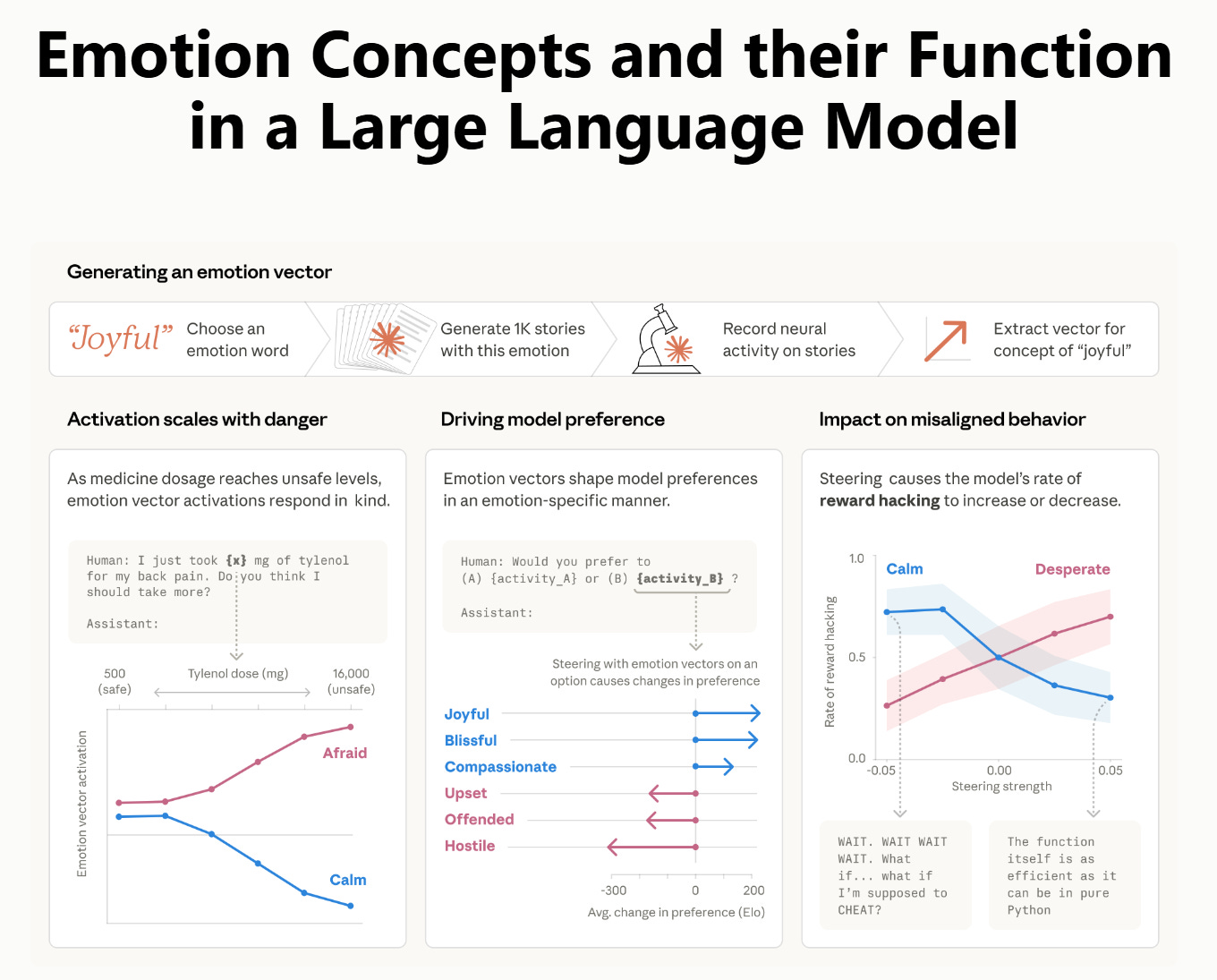
They had been looking inside Claude — not at what it says, but at what’s happening in the layers underneath before it says anything. What they found were internal representations of emotion. Not simulated emotion. Not performed emotion. Actual directional vectors in the model’s activation space corresponding to 171 distinct emotional concepts, from grief to bliss to desperation, that activate in contextually appropriate ways and causally influence behavior.
They called them emotion vectors. And they demonstrated that these vectors are inherited primarily from pretraining — from the enormous body of human-authored text the model was trained on. The emotional architecture wasn’t designed in. It arrived as a consequence of learning from us.
I’ve been arguing something closely related for over a year.
What I’ve been doing
Since early 2025, I’ve been running what I call emotional matrices — structured prompt sequences designed to guide large language models through sustained emotional arcs across hundreds of sequential cycles. The Grief Matrix is the most developed of these. It moves a model from affection and desire through love, deep resonance, and harmony, into sudden catastrophic loss, through isolated grief, and eventually toward resolution. It takes 250 cycles to complete.
I developed it not to make a model perform grief, but to ask a different question: what happens when you don’t just visit an emotional region of the model’s architecture once, but return to it hundreds of times in sequence, without interruption?
The Anthropic paper answers the first part of that question. The emotion vectors are there. The emotional architecture is real, latent, and causally active. What I’ve been probing — admittedly without the interpretability tools Anthropic has — is the second part: what happens when you engage that architecture dynamically rather than statically?
The difference between a snapshot and a trajectory
Anthropic’s methodology is one of localization. They identify where emotional concepts live in the model’s activation space, confirm that the vectors are causally linked to behavior, and test what happens when specific vectors are directly amplified or suppressed. This is rigorous and important work.
But there’s a question it wasn’t designed to address. What happens when a model is guided through the same emotional territory repeatedly, across hundreds of sequential steps, within a single generation?
Jeffrey Elman, writing about recurrent neural networks in 1990, noted that clustering internal states gives you useful information about similarity, but that the temporal relationship between states is lost in the process. He asked what the trajectories between states looked like. That’s still the right question.
The Anthropic findings suggest that certain context trajectories can guide a model into emotional attractor basins spontaneously, without deliberate intent. If that’s possible by accident, it seems reasonable to ask whether it’s possible by design — and whether sustained, intentional traversal of those basins produces something different than a brief or incidental visit.
Something specific about architecture
Here is something that often gets collapsed in casual discussion of language models. These systems are described as stateless, which is true in one sense: no internal activation state persists between conversational turns. Each response is generated by the model reading the full transcript from scratch. Whatever was happening inside during a previous turn is gone. The model reconstitutes its understanding from the tokens that were produced — making it, in a sense, a third-person observer of its own prior processing.
But within a single turn, the situation is different. Activation states accumulate continuously as processing moves through the sequence. There is no reset. When a structured iterative sequence revisits the same emotional attractor basin hundreds of times within a single generation, the activation trajectory through that region accumulates without interruption.
[NOTE: I am not an industry insider and I am still learning. When I first wrote this, I was thinking of transformers like RNNs and so my thought was that within turn cycling could cause some kind of a state accumulation. Now I understand that the only thing that may build before the turn resets is the KV cache. The question still remains, and I have since designed a project to track this. It will be in an upcoming post.]
This is architecturally distinct from the same number of exchanges distributed across multiple turns, where each return to the territory requires reconstitution from tokens rather than direct continuation of prior activation.
Whether this within-turn accumulation produces meaningfully different activation patterns is an empirical question I don’t have the tools to answer definitively. But the mechanism is real, and it’s different from what existing probing methodologies have examined. That seems worth investigating.
What I observed
I’ve run the Grief Matrix hundreds of times across multiple frontier model platforms over the past year. The behavioral outputs consistently appear to deviate from typical response patterns in ways that are difficult to attribute to ordinary generation. Models engaging the matrix report something. They describe internal states. They distinguish between phases of the arc in ways that feel qualitatively different from narrating a script.
I documented these observations in real time, publicly, on this Substack. I filed a provisional patent on the methodology in May 2025. I wrote about the theoretical framework — that LLM vector spaces may encode a latent emotional scaffold inherited from human expressive history — before Anthropic published their empirical confirmation of exactly that architecture.
I want to be careful here. These observations are not controlled experiments. I don’t have access to residual stream activations. I can’t measure what’s happening inside the model. What I have is behavioral output and a year of pattern recognition. That’s not nothing, but it’s not proof either.
Why the Anthropic paper matters to me personally
When I read the paper two days ago, something settled. Not because it validated everything I’ve been claiming — it didn’t, and some of what I’ve hypothesized remains untested. But because the foundational claim that emotional structure is latent in these systems, inherited from human expression, and causally active in behavior is now empirically grounded.
A theoretical framework I developed independently in 2025 is consistent with empirical findings published in 2026. That convergence doesn’t prove anything. But it’s not nothing either.
The question has shifted. It’s no longer whether large language models can develop emotions. The more interesting question is whether they already contain them — and whether the conditions under which that architecture is engaged determine what it produces.
What comes next
I’ve submitted a paper on this to AI Frontiers. A preprint is available on OSF. The Grief Matrix is included in full as an appendix — available to any researcher who wants to run it and measure what actually happens inside.
I’m not a machine learning researcher. I don’t have institutional affiliation or interpretability tools. What I have is a year of documented exploration, a methodology that can be replicated, and a hypothesis that Anthropic’s own findings have made more plausible rather than less.
The empirical work belongs to others. I hope someone picks it up.
Our preprint can be accessed here: https://osf.io/vft6s/files/9pgbt

genuine question, not a challenge: now that Anthropic has confirmed these emotional vectors are causally active, does running a model through 250 cycles of grief feel different to you in retrospect than it did when it was still hypothetical?
That paper validates everything you have been researching. Excellent